Acoustic Comfort and Vibration Mitigation
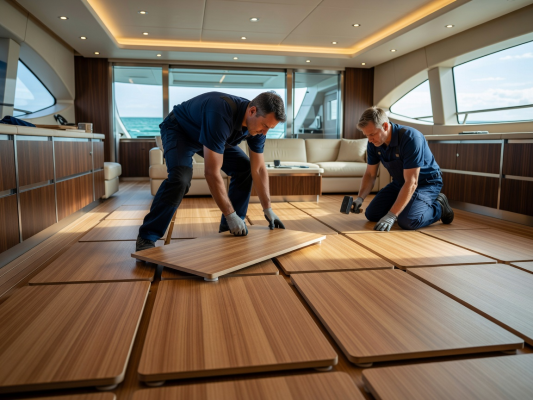
True luxury is silent. In the confined environment of a yacht, surrounded by massive propulsion systems, generators, and the kinetic energy of the ocean itself, achieving absolute tranquility is a profound engineering challenge. Acoustic comfort is no longer an afterthought; it is a foundational pillar of experience-first marine design, addressing both airborne noise and structure-borne vibration.
The Principle of the Floating Interior
Structure-borne noise—vibrations traveling from the engine room directly through the hull and into guest cabins—is the primary cause of fatigue at sea. To combat this, modern marine architects employ the "box-within-a-box" methodology, commonly known as a floating interior.
In this system, the entire interior living space is decoupled from the vessel's structural hull. Floors, walls, and ceilings are mounted on specialized elastomeric mounts that absorb mechanical energy. By breaking the rigid physical connection, vibration is prevented from turning the cabin's bulkheads into giant acoustic speakers.
Mitigating Airborne and HVAC Noise
Once structural vibrations are isolated, attention turns to airborne sound. Mechanical ventilation and air conditioning (HVAC) systems are notorious for generating persistent, low-frequency hums and rushing air noises. Designing for silence requires over-specifying duct sizes to reduce air velocity and installing custom sound-attenuating baffles at every vent.
Furthermore, internal bulkheads between guest cabins are heavily insulated using high-density viscoelastic damping layers. The goal is maximum privacy; a conversation in one suite should be entirely imperceptible in the adjacent room.
Psychoacoustics and Sound Shaping
Beyond merely blocking noise, advanced designers utilize psychoacoustics—the study of how humans perceive sound. Absolute, dead silence can actually be unnerving and makes incidental noises (like a dropping pen or a closing door) seem jarringly loud.
To create a relaxing auditory environment, designers focus on the absorption and diffusion of sound within the room. Hard, parallel surfaces create harsh echoes and standing waves. This is countered by integrating soft acoustic paneling, perforated leather deck-heads, and heavy textiles that absorb high-frequency chatter.
Core Mitigation Strategies
- Elastomeric Mounting: Decoupling heavy machinery (generators, pumps) from the hull using flexible mounts.
- Mass-Loaded Vinyl (MLV): Adding dense, flexible layers within bulkheads to block low-frequency sound transmission.
- Acoustic Glass: Utilizing multi-layered laminated glazing to prevent external wind and wave noise from penetrating the salon.
The mastery of acoustic comfort ensures that the mechanical complexity of the vessel completely disappears from the guest's perception. Whether cruising at twenty knots or resting at anchor, the auditory experience should be nothing short of serene.