Tactile Materials and Sensory Design
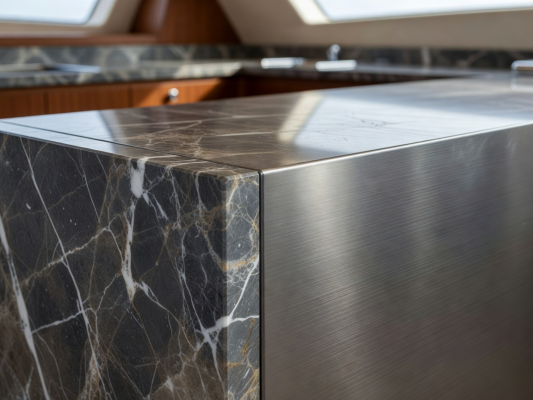
In an increasingly digital and sterile world, luxury design has pivoted sharply towards the tactile. The yachting environment provides a unique canvas for sensory design, where users interact intimately with their surroundings—often barefoot and in direct contact with surfaces. Consequently, material selection is no longer just a visual exercise; it is an investigation into thermal conductivity, texture, and emotional resonance.
The Imperative of Barefoot Comfort
Yachting is perhaps the only luxury sector where users frequently traverse the environment without footwear. This elevates flooring from a mere aesthetic choice to a primary tactile interface. The transition from sun-baked exterior decking to an air-conditioned interior must be managed carefully to avoid shocking thermal shifts.
Modern alternatives to traditional teak are being engineered not only for sustainability but for their thermal properties. Open-pore timbers and specifically formulated composite resins are selected to retain warmth without becoming dangerously hot under direct UV exposure, while plush, hand-tufted interior carpets provide immediate soft-tissue relief upon entering a cabin.
Marine-Grade Durability Meets Natural Aesthetics
The marine environment is notoriously hostile to fine materials. Salt ingress, aggressive UV radiation, humidity fluctuations, and structural movement require robust engineering. The challenge for experience-first design is maintaining the authentic feel of natural materials while meeting these rigorous technical requirements.
We see a strong shift away from high-gloss lacquers—which feel cold and artificial—towards open-pore woods, honed stones, and brushed metals. These finishes not only disguise fingerprints and micro-scratches better than their polished counterparts, but they also invite touch. The friction of a leather-wrapped handrail or the subtle grain of a bleached oak bulkhead communicates authenticity and grounding.
The Role of Soft Furnishings
Soft furnishings play a dual role in sensory design: providing physical comfort and significantly altering the acoustic signature of a room. High-performance outdoor fabrics have advanced to the point where they are indistinguishable from delicate interior bouclés and chenilles in hand-feel, allowing for a unified aesthetic that flows seamlessly from the salon to the aft deck.
Layering textures—pairing a smooth, cool linen sofa with heavy, coarse wool throws—creates micro-environments that users can adjust according to their thermal comfort and mood. This tactile variety prevents the sensory fatigue that can occur in spaces finished with a single, uniform material.
Evaluating Materials for Sensory Impact
- Thermal Mass: How quickly a material absorbs and releases heat (e.g., stone vs. wood).
- Acoustic Absorption: The capacity of wall coverings, such as suede or acoustic felt, to dampen harsh frequencies.
- Light Reactivity: How textured surfaces diffuse light, creating soft gradients rather than sharp, glare-inducing reflections.
Ultimately, a successful tactile palette is one that feels grounded, authentic, and inviting. By prioritizing how a space feels to the touch over how it photographs, designers create marine environments that offer genuine psychological restoration.